
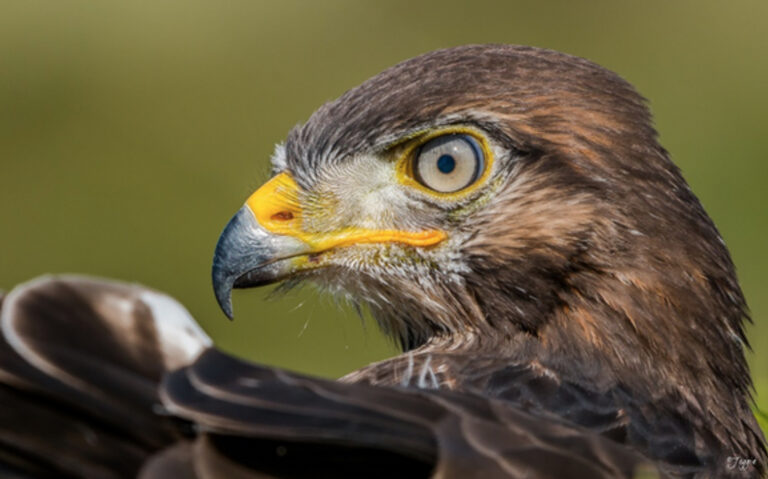
The Jackal Buzzard
The jackal buzzard (Buteo Rufofuscus) is a fairly large African bird of prey. This species lives among mountains and on adjacent savanna and grassland. It is resident and non-migratory throughout its range.
Physical Attributes: Jackal buzzard adults measure 44-60 cm in total length with wingspans ranging from 127-143 cm. Males weigh in at 790g-1.37kg, while females tip the scale at 1.15-1,7kg.
The plumage of adult jackal buzzards is rufous and distinctive. Primary flight feathers are dark, secondaries off-white, and both are barred with black. Feathers around the throat are mainly chestnut, with the rest of the underparts and the underwing richly rufous, but for a contrasting black abdomen with faint white bars.
Seen from below, the flight feathers present a large white panel, contrasting with a dark trailing edge to the wing. Beyond its unmistakable colours, the jackal buzzard has a very short tail, broad wings, a bulky body and large bill.
The jackal buzzard’s call has a sharp, barking quality (weeah ka-ka-ka or kyaahh-ka-ka-ka), the female’s call being deeper than that of the male. Its call is reminiscent of that of black-backed jackal and is believed to be the source of the species’ common name.
Distribution: The jackal buzzard is endemic to southern Africa. Despite its limited range, it is a fairly common species of raptor. It inhabits most of South Africa and its range extends in the west up to central Namibia, in the east through Lesotho and Eswatini into south Mozambique and, to the north, in extreme southeast Botswana. The jackal buzzard is largely a mountain-dwelling species, but can range from low rocky outcrops at sea-level to high mountainous areas in Lesotho up to 3,500 m. This adaptable bird can thrive in desert-like, arid conditions and areas with high rainfall and verdant plant life. Mostly it prefers to be close to grassland in which it most of its hunting takes place.
Status: The jackal buzzard’s status is listed as “Least Concern” on the IUCN Red List, indicating that its population trend is stable and it is not facing significant threats. While the species is common and adaptable, it can be impacted by human-made structures like wind turbines and vehicle collisions, and some individuals are poisoned. However, these threats are not widespread enough to classify the species as endangered
Behaviour & Food: Pairs exhibit noisy aerial displays, usually confined to circling or gentle stooping, including outside the breeding season. The diet of the jackal buzzard consists in the main of small ground mammals, especially rodents. Other prey may include snakes, lizards, ground-feeding birds such as sandgrouse and gamebirds (or alternately the nestlings and fledglings of other birds), insects and road-kill. Typically, this raptor still-hunts by dropping on its prey from a perch, such as trees or roadside posts. It may also hunt by soaring, hovering or hanging on updraft.
Breeding: The breeding season peaks in July to December. The large stick nest is built in a tree or on a crag and is often reused and enlarged in subsequent seasons. When first constructed, the nest averages 60-70cm in diameter and +/-35 cm deep. It can easily can exceed 1m in diameter with repeated use. Two creamy or bluish white eggs (or very rarely three) are laid at about three day intervals and incubated by the female. The male brings food to her whilst she is on the nest. The eggs hatch after about 40 days and parents will protect their young by attacking any intruders who come too close to the nest. Nestlings will attempt flight 56–60 after hatching. At 70 days the chicks become independent of the nest, but young birds may be seen with the adult pair for some time.
Keep your eyes open as you explore the estate. You may be lucky enough to spot these magnificent raptors soaring above.
Adapted from a March 2025 newsletter article by Joggie van Staden, Environmental Management.
Sources: Wikipedia, Birdlife Data Zone, Animalia